Chagas
Disease
American Trypanosomiasis.
PKGhatak, MD.
Chagas
disease is named after Dr. Carlos Chagas of Brazil. Trypanosoma cruzi causes Chagas disease in South America, and Trypanosoma gambiese
causes Sleeping Sickness in Africa. Several species of Leishmania are pathogenic to humans, and both Trypanosoma and Leishmania belong to one family.
In 1909,
Dr. Chagas investigated an unknown illness that was common in the
rural areas of Brazil. He found a blood sucking insect feeding on
humans and leaving behind feces and urine near the wound. The excreta of the kissing bug were loaded
with the infective form of the parasite. The victims, while sleeping,
rubbed the feces and contaminated the wound and the parasite also
entered the body through the conjunctiva of the eyes.
Trypanosoma cruzi can infect in other ways - Contaminated food and drink by
vectors' feces and urine often cause local endemics, contaminated
blood transmission and organ transplantation are less common. Mother to child
transmission during pregnancy is a major concern, and the children in subsequent pregnancies are also infected.
The
victims developed illness in two phases – 1. The initial or the
first stage. 2. The chronic stage.
The
initial stage.
The
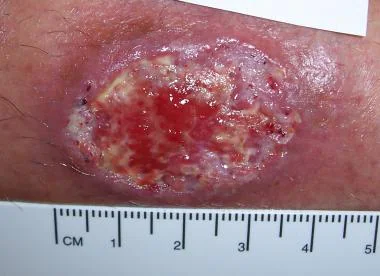
initial illness is a mild local inflammation and the regional lymphadenitis and in a few instances only mild systemic symptoms. Occasionally, a furuncle, called Chagoma, develops at the wound
site. The illness is self limited. About 50 % of new infections may
remain symptom-free.
In the
2nd
or Chronic phase.
Years
may pass without any signs of illness, and then patients present with symptoms of serious heart, gastrointestinal and neurological diseases.
The
parasite Dr. Chagas discovered was a flagellated Protozoa in the blood
of the victims. He conclusively proved the pathogenicity of the
protozoa by recovering the same organism is susceptible animals. Dr
Chagas named the parasite Trypanosoma cruzi to honor his mentor Dr.
Cruz.
The
Life Cycle of the Protozoa Parasite:
The
organism is a motile, unicellular organism having one flagellum. The
protozoa have 5 stages of development and two methods of propagation
- one by binary fission and the other by sexual union. The different
stages of life of the protozoa are named according to the point of
attachment of the flagellum to its body or the absence of the flagella.
The Greek word for the flagella is mastigot. The infective form that
circulates in the blood of the victims is called Trypomastigotes.
Inside
the bug.
In the
midgut of the insect, the trypomastigotes transform into
Epimastigotes, having the flagellum attached to the end of the body.
Here epimastogotes multiply, and the epimastogotes enter the hind gut and transform back to Trypanostigotes, and infect humans when the
bug takes a bloody meal.
In the
victim.
The
Trypomastigotes transform into a round, small unicellular organism
inside the victims' cells. The parasite has no visible flagella and is called Amastigotes. Amastigotes multiply by binary fission.
Amastigotes transform into trypomastigotes and burst open the victim's
cells. The released Trypomastigotes infect more tissue, and also
enter the bloodstream and lymphatics and are widely distributed in the
body. Some of the Trypomastigotes switch back to Amastigotes, divide again and keep on multiplying by binary division. And the
cycle repeats again and again.
Besides
humans, small animals like monkeys, armadillos and dogs are also
infected.
The
insect vector.
The
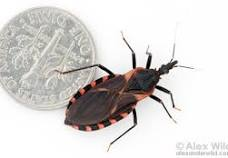
bug that transmits Chagas disease is a Triatomine bug, a variety of Reduviid bug, locally known as the Kissing bug, as they find it on the faces
of victims.
There
are several species of the Triatomine bug, one species is active in a certain locality, or another. The bug is active at night. They come out
of cracks of the wall, fall from the ceiling, or just crawl on the bed
from outside. The bugs bite on the faces of humans (part not covered during cold nights). A recent report says the oral route of infection, in recent days, has been the dominant path of infection of Chagas disease.
Chagas
Disease:
The
incubation period is short.
The
initial illness is mild and self limited, and often remains asymptomatic.
The
chronic phase of Chagas disease is a protracted severe symptomatic disease of the cardiovascular, gastrointestinal, and Neurovascular systems. The mortality rate is high and the disability is severe.
Pathophysiology:
The amastigotes invade muscle cells of the heart and the smooth muscles of
the esophagus, and colon, and also invade the brain. The inflammatory reactions are mediated by acute phase Cytokines. The initial myocarditis is followed by necrosis of the muscles, which are replaced by fibrous tissues. The
cardiac and smooth muscles of the GI tract become weak and flabby. The
heart is the most common organ affected by Chagas disease. Cardiac impulse propagation along the His bundle due to fibrosis
manifests as heart block, branch block, cardiac arrhythmia and systemic embolism.
Massive dilated cardiomegaly and heart failure are the prominent
features of this disease. Megaesophagus leads to difficulty in
swallowing solid food, and megacolon leads to chronic constipation,
abdominal distention and discomfort.
The
CNS infection results in strokes and many other neurological
manifestations.
Diagnosis:
The
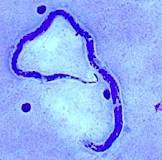
mainstay of diagnosis of Chagas disease is the demonstration of
moving Trypomastigotes under the coverslip of a thick smear of
blood. Under the trained eyes, the movement of the transparent
parasite around stationary red cells is not difficult. It is a cost-effective test and practical in the rural communities.
Other confirmatory tests and PCR antigen detection and indirect ELISA
antibody detection.
Medical
treatment:
Two
oral medications, Benznidazole and Nifurtimox, are effective in
killing the parasite but the drugs must be given early in the acute
phase of the disease in children 2 to 18 years of age. The older
adults develop toxic side effects more frequently, and drug therapy is not recommended in adults. Women of reproductive age are tested and treated with drugs to prevent congenital Chagas disease.
Benznidazole
is an imidazole derivative, active against intracellular parasites. In
Chagas disease, the drug is prescribed for 60 consecutive days. The
drug inactivates parasitic enzymes and damages DNA and large protein molecules by generating cation radicals. Common side effects of this
drug are various GI symptoms, skin rashes, peripheral neuritis,
thrombocytopenia, leukopenia, and anemia.
It is potentially carcinogenic.
Nifurtimox
is a nitrofuran drug. The mode of action of Nifurtimox against the
parasite is similar to Benznidazole and it generates radicals
through its action on nitrogenous enzymes. The adverse reactions are
also like Benznidazole. But when prolonged treatment is necessary,
Nitrofurans is not suitable because of its adverse effects, which are
more intense than Benznidazole. Both drugs are contraindicated in
pregnancy.
Surgery:
In the past, various types of cardiac surgery were tried to improve the function of the failing, frail and flabby heart muscles. In the long run, none of
those procedures proved to be beneficial and subsequently abandoned. Heart block is effectively treated with cardiac pacemakers. Only cardiac transplantation is a solution for severe heart failure.
Megaesophagus.
Laparoscopic myomectomy, esophageal mucosectomy are less involved procedures. Heller-Pinotti
procedure is a more involved operation and is done in early swallowing difficulties. It is a modified Fundoplication operation.
In
advanced cases, the Thal-Hatakufu operation is done. In this operation, Esophagogastricplasty is performed. The success of the Thal-Hatakufu operation is moderate.
Megacolon.
A
Total Colectomy operation is required with anastomosis with -(a) ileorectal, or, (b) ileoanal, or, simply a colostomy.
Prognosis
of Chagas disease depends on the stage of the disease. In the early active phase, the drug treatment is curative.
The
survival in the chronic phase is poor.
Incidence and prevention of Chagas disease.
18 million people in 21 countries of Central and South America are
infected with Trypanosoma cruzi and 100 million people are at risk of
infection.
Insecticide is used to control the insect vector. Better housing and
public education have been successful in bringing down the
spread of Chagas disease.
***************************************************